Will of F. A. Hilbun, 1872, Tunica County, Mississippi
1872 WILL of F. A. Hilburn– Tunica County, Mississippi.
Transcribed by Joy Hilbun Mohr from Microfilm copy of WILL from Mississippi Dept. of Archives and History, Jackson, MS. In addition, this will is now availabe on Ancestry.com. That one appears to be a transcription of the original will and there is very little to no punctuation within the will.
The last will & Testament of one F. A. Hilburn being of sound mind but knowing the uncertainty of human affairs knowing that life is short & death certain I hereby direct that after my death all my just debts & funeral expenses be paid that my personality be first exhausted to the payment of my debts & if there be not sufficient therefore that my plantation on which I now reside be rented leased or cultivated as to my executors may seem best & the profits arising therefrom be appropriated to the payment of my said debts & after the same shall Have been thus paid I direct that my plantation be continued to be cultivated or rented as to my executors may seem best & that the profits arising there from be appropriated to the maintenance of my two daughters Susan F. Hilburn, Sarah A. M. Webster until they shall marry & to the education & maintenance of my three sons Andrew J. Hilbun, Fredrick A. Hilbun & Lemuel T. Hilburn until they respectively attain the age of 21 years & that after my youngest son attains the age of 21 years or in case of his death also then when my next youngest son attains the age of 21 years I will & direct that all my property both real and personal be equally divided among all of my children then living to wit Susan F. Hilbun Sarah AM Webster, Andrew J. HIlbun, Frederick A Hilburn, Lemuel T. Hilbun and William W. Hilburn I do hereby appoint DJ Richmond, JV Bridgforth, and George C. Summerwill as executors of this my last will and testament.
I do hereby nominate and appoint GC Summerwill as Guardian of my sons Andrew J Hilbun, Frederick A> HIlbun and Lemuel T Hilbun this the 9th day of November 1872.
F A Hilburn (seal)
Signed sealed published and declared by this said F A HILBURN as his last will and testament in the presence of us who in his presence and in the presence of each other & at his request have herewith set & subscribed our names & seals this the 9th day of November 1872.
GC Summerwell
F. J. Phillips
John O Donnell
J. V. Bridgeforth
State of Mississippi. Tunica County.
In the Chancery Court of Tunica County of said County. Jany. Term AD 1873
IN the matter of a certain instrument of writing purporting to be the last will & testament of F. A. Hilbun deceased. Be it remembered that at a term of the chancery court of the county & state aforesaid bequest and held at the court house in and for said county on the first Monday in January 1873 personally appeared in open court, GC Summerwell & J V Bridgeforth subscribing witnesses to the last will and testament of F. A. Hilburn, deceased late of said county who having been first duly sworn deposed and said that the said F. A. Hilbun signed published and declared said instrument as his last will and testament on the 10th day of November 1873 the day of the date of said instrument in the presence of those deponents and T. J. Philips, John O’ Donnell the other subscribing witnesses to said instrument that said testator was then of sound and deposing mind and memory and twenty one years of age and upwards and that they the said deponents and the said T.J. Philips John O Donnell subscribed and attested said instrument as witnesses to the signature & publication thereof at the special instance & request and in the presence of each other on the day and year of the date thereof
J V Bridgforth
Sworn & subscribed
This 8 day of
January 1873
Clb Dunaway??
My notes regarding this will……. This will of F. A. Hilbun appears to be of Frederick Hilbun, son of Woodward Hilbun. They both are found in the 1850 Census of Pontotoc County, MS. Frederick is in Pontotoc in 1860 and in Tunica County, MS in 1870.
Make a one-time donation
Make a monthly donation
Make a yearly donation
Choose an amount
Or enter a custom amount
Your contribution is appreciated.
Your contribution is appreciated.
Your contribution is appreciated.
My Reasons for Becoming a Baptist- by Rev. Stephen N. Hilbun. 30 Jan 1851
The following is a transcription of an article which appeared in the Alabama Baptist paper, Southwestern Baptist, on January 30, 1851, written by Rev. Stephen Newberry Hilbun. This same article was also published in the Tennessee Baptist paper the following month. These articles can be found on Newspapers.com with a subscription.
Stephen N. Hilbun’s great-great grandson, Rev. Joel P. Hilbun transcribed the article. It follows:
“On a certain occasion I stood, as a spectator, on the water’s edge, where the solemn ordinance of Baptism was to be administered by a Baptist minister. He declared that believers are the only subjects, and immersion the only mode, of baptism known in the New Testament; and although I had heard as much affirmed many times before, on this occasion a powerful impression was made on my mind. Is it a fact that the Scriptures furnish neither precept nor example of Baptism by sprinkling or pouring, nor of infants as subjects? Would Baptists constantly and openly affirm such a thing and no one be able to put them to silence, if they have not the Word of God to sustain them? Is the prejudice of education—is the force of circumstances of associations—sufficient to shut our eyes to facts as plain and palpable as Baptists say they are, in this case? Thus, perplexed and reflecting, I turned to the New Testament and sought carefully, patiently, and I think, honestly, for the truth, willing to know and practice it as far as capable. The result of that investigation was, I came fully and satisfactorily to the following conclusions.
1. The Baptism of John, the disciples of Christ, and the apostles was, without the least possibility of successful contradiction, immersion only, and that of believers, in the name of the holy Trinity.
—For instance the baptism of Jesus in Jordan—John ‘baptizing in Enon near to Salim because there was much water there”—Philip and the unoch both went down into the water, &c. In short whatever the manner of the baptismal action is hinted at, it is most clearly to my mind immersion. And as to the proper subjects. The Bible contains not one most distant allusion the baptism of infants, or any but believers in the Lord Jesus Christ. But believers, “both men and women,” Acts 8:12—“those who had received the Holy Ghost, Acts 10:47—Lydia, hearing Paul preach by the “river side” and her household in which it is not likely there were many infants, and certainly no proof, Acts 16:14, 40—the Jailer ‘with all his house rejoiced believing in God’ 34—Chrispus ‘believing in the Lord with all his house,’ Acts 18:8—Stephanas and his house, who ‘addicted themselves to the service of the saints,’ 1 Cor. 1:16—these were baptized & such as these, but no infants, in apostolic times.
2. There being no Bible authority for infant baptism or any other mode of immersion, the usage of the Baptist church in this respect, is consistent and Scriptural. I am acquainted with the logic of learned Pedo-baptists; but it can not satisfy minds that take an intelligent and impartial view of both sides of the question. But I do not say this to question or impeach the candor and honesty of my brethren whom I have left. I doubt not their honesty; but I think they have looked at only one side of the question, or looked through colored glasses as I did.
3. With these views, honesty and candor compelled me to dissolve my connextions with the Methodist Episcopal church, and seek a connexion with that church which clings to the Bible and repudiates the doctrines and commandments of men, in ecclesiastic faith and practice.
Thus, beloved brethren and friends, I have given in a few words, my principle reason for becoming a Baptist, and, I think honestly, as in the sight of God. For the last twenty years I have been a Methodist, and nine years of that time have been trying to preach the Gospel. I was contented in that church, and have been satisfied with her usages and doctrines, and enjoyed the consolations of religion, as well as I expect to in the Baptist church; but a sense of duty, and a conviction of truth, have influenced me in this step, and I feel that God is with me, and his word sustains me in the confident belief that I am right.
I do not by any means, discard infant salvation because I do infant baptism. Baptism is no Saviour—Christ the Lord of glory crucified, is the only Savior; & we must obey him as King in Zion & Head of all things to the church, even if his commandments do clash with our prejudice & education. Unconscious infants cannot obey, nor is there any commandment in the Scriptures addressed to them, or obligatory upon them until they are capable of understanding something of its import; & a proxy obedience to a divine law or requirement, is either inconsistent, or else for all I can see, might be extended as in the Catholic church, to supererrogation, so that the son or daughter might be saved for the righteousness of sponsors or parents.
May the Lord help us by his Word and Spirit to live to his glory, and when our pilgrimage has ended, save us in his kingdom.”
Stephen Hilbun
Brooklyn, Ala., Jan. 30th, 1851
Transcribed by Rev. Joel P. Hilbun, great-great grandson of Stephen Hilbun.
Brief Biography of Stephen Newberry Hilbun (1805-1888). Part 1.
Written by Joy Hilbun Mohr
My third great-grandfather was Stephen Newberry Hilbun. The majority of members of this Hilbun/Hilburn Facebook page are descended from him! The other members I believe are descended from cousins of Stephen’s father.
Stephen N. Hilbun was buried in the Big Creek Baptist Church Cemetery in Jones County, Mississippi. His tomb simply says, “Rev. S. Hilbun.” At the time of his death, in 1888, he was living with his son JohnWesley Hilbun who was the step-father of my great-granddad Stephen F. Hilbun.
According to the Bible record of his father, Frederick Hilbun, Stephen was born in December 1805. Stephen (SNH), was the last of eight children born to Frederick and Nancy Hilbun. Unfortunately, Nancy died in April 1810, when SNH was not yet five years of age. Frederick remarried and had at least seven more children and moved from Burke County, Georgia to Montgomery County, Alabama sometime in the 1820’s.
In 1828, Stephen married Priscilla Hannah in Montgomery County. They had twelve children, one of whom was my 2nd great-grandfather William. Priscilla died in 1846 and a few years later SNH married Sarah Smith. They had seven children and later settled in Pike County, Mississippi. Many descendants of this branch settled in southwest Mississippi and in Tangipahoa Parish, Louisiana.
From the 1850 Federal Census Record of Butler County, Alabama, we know that SNH was a blacksmith. He also must have felt a calling by God to preach as he was ordained by the Methodist Episcopal Church in 1849.
Earlier in 1843, his older brother Joseph Hilbun gave land for a new church to be built in Butler County; this church was Bethel Methodist Church. Stephen and his older brothers, John, Joseph, and William Hilbun, were mentioned in that deed transfer as “trustees” of this church. The fact that these Hilbun men were part of the beginnings of this new church causes one to believe that the Lord Jesus Christ and His church were important in their lives.
The minutes of Bethel Methodist Church have largely been lost but in a remnant found from 1836, only two Hilbuns were listed as members- Henry Hilburn and his wife Keziah. It stated that they “removed “in 1836, suggesting that they moved elsewhere. We do know that Henry Hilbun was in Randolph County, Georgia in 1840.
SNH must have been a deep, contemplative man as just a few years after having been ordained by the Methodist Episcopal Church, he came under conviction that baptism of infants was in error. He became a Baptist and in 1851 was ordained in the Baptist church. Shortly before his ordination, he wrote an article, “My Reasons for becoming a Baptist”. This article was published in the Alabama Baptist State Paper in February of that year. Upon reading this article, it is obvious that my 3rd great-grandfather Stephen Newberry Hilbun was well educated!
His article has been transcribed by my father, Rev. Joel P. Hilbun, also a Baptist pastor.
William Hilbun 1831-1863- researched & written by great-grandson, Joel P. Hilbun.
NOTE: Feel free to use this information but please acknowledge the source- manuscript by Joel P. Hilbun.
William Hilbun was the third child of Stephen Newberry Hilbun (1805-1888) who was the eighth child of Frederick Hilbun (1768-1850). William was born July 7, 1831 in Lowndes County, Alabama. He married Susan Elizabeth Beard July 3, 1855 in Monroe County, Alabama (Monroe County, AL Marriage Book A) and security was provided by Joseph C. Lambert. Susan was the oldest child of Moses Beard and was 22 years old when she married William. Moses Beard was found in the 1850 census of Monroe County, Alabama. Susan Beard’s sister, Martha married William’s younger brother, David Frederick Hilbun and they also moved to Wayne County and later to Laurel, Mississippi.
William and Susan Hilbun had three sons: Andrew Jackson, born in Alabama in 1856; Steven Filmore, born in 1858, and William P., born in 1860. The youngest boys were both born in Wayne County, Mississippi.
William purchased land in Wayne County, Mississippi, on September 8, 1857- 43.20 acres in Township 10 North, Range 7, Section 31, NE4 NW4, for $108, record # 13632. This land joined that of his father-in-law, Moses Beard. A certificate for a Land Patent was issued by the Augusta Land Office on November 10, 1859. On the certificate his name appears five times as “William Hilburn” with the “r” scratch through each time.
On January 9, 1861 Mississippi was the second state to secede from the Union, and on April 12 of that year the War Between the States began with the firing on Fort Sumter in South Carolina. As many men began enlisting to fight for the Confederacy, on March 8, 1862, William and his younger brother, John Wesley, enlisted in the Shubuta Guards of Clarke County, Company E with T. T. Howze, a Clarke County farmer, as captain. Organized March 1, 1862, the regiment was first called the 37th Mississippi Volunteers. Shubuta, the nearest enlistment station, was just a few miles from where he lived in Wayne County. On April 28, 1862, ten companies from the counties of Clarke, Jasper, Lauderdale, and Smith, rendezvoused at Columbus, Mississippi, and there they were mustered into the Army of the Confederate States of America as the 37th Mississippi Infantry Regiment with a total of 888 men, including field officers and staff. The date on William’s service record states that he enlisted on May 13, 1862, by Col. Orlando S. Holland, who had been editor of a newspaper in Enterprise.
William’s unit participated in the Battle of Iuka on September 19, 1862, after which his company was moved into position for the defense of Corinth as a major railroad center. On October 3 there began a three day siege by Federal armies. William’s service record dated October 13 records that he was absent from his company, the reason being that he was wounded in action at Corinth, Mississippi on October 3, 1862 and sent home. His Company Muster Roll for November and December recorded him “absent, wounded in action, Corinth, and in hospital.” The January and February records show “absent, in hospital.” There is a Hospital Muster Roll of General Hospital at Enterprise, Miss., that says “to February 28, 1863, dated February 28, 1863, listing William ”present” as a patient.
Sometime after February 28 William rejoined his regiment which was alrea dy engaged at Vicksburg. In the fierce fighting that led to the surrender on July 4, the casualties of the 37th were 17 killed and 56 wounded. One of those wounded was William. He was captured and taken as a Prisoner of War on July 4, 1863 but was paroled on July 6.
The Company Muster Roll for April 30 to October 31 states “Died in hospital, Vicksburg, Miss., July 15, 1863.” He was buried near Vicksburg in Cedar Hill Cemetery, in a section established in 1866 for Confederate Soldiers called Soldiers Rest, in the Mississippi Section. His grave marker is inscribed:

“PVT WILLIAM HILBURN
CO E MISS INF CSA
JUL 7 1831 – JUL 15 1863.”
(picture- author and daughter Kaye at William’s grave)
William’s younger brother, John Wesley, was discharged by order of General Johnston sometime between April 30 and October 31, 1863. After he returned from the war, he married William’s widow, Susan Elizabeth, probably in 1865. In about 1879 the family moved from Wayne County to Jones County, Mississippi. An oral tradition has it that they were intending to move on to Texas, but were caught in west Jones County by a very unexpected snow storm. Stranded there for some days, they were treated so well by the Wade family that they decided to just settle in Jones County.
John Wesley Hilbun raised William’s sons and had more children with Susan- Lula, Theodocia, Mary Katherine, John T., and Daniel Benjamin.
William’s son, Stephen Filmore Hilbun grew up in the Big Creek area of Jones County and in 1881 married Mary Almedia Wade, daughter of Daniel Webster Wade and Cornelia Knight Wade. They had the following children- Doctor Franklin, Charles William, Nola Lavada, Persada, Bruce Sharp*, Daniel Wesley, and William Hobson.
*Bruce Sharp Hilbun married Cammie V. Miller and they had the following children, Billy S., John C., Charles C., Joel P., Robert B. and Thomas E.
WILL of John Hilburn 1728, Queen Anne’s County, Maryland
NOTE: We don’t know who this John Hilburn was. I include it so that others can hopefully connect the dots through due research and documentation.
This will is transcribed by me, Joy Mohr. I’ve tried to stay true to the spelling found in the will; the name Hilburn is spelled in various ways within the same document. In addition, there is basically no punctuation within the will.
In the name of God amen, the 18th day of January in the year of our Lord God, 1728, I, John Hilburn of Queen Anne County, being very sick and weak in body but of perfect mind and memory thanks be to God for it calling unto mind the mortal of my body
First and foremost I desire my son Willm Hillburn to stay with my well beloved wife Frances Hellborn until he comes of years of one and twenty as also I desire my son Jeh Hellborn to stay at his brothers above mentioned as all soe I leave to my well beloved friend Mark Hargedine. and Jane his wife my daughter Elizabeth Hellborn until shee comes to the eage of 18 years and the said Mark Hargedine and Jane his wife, in consideration thereof must learn the said Elizabeth Hellborn to read, nit, spin soe and doe housework. (read, knit, sew and do housework). After I give and bequeath to my dear loving wife Frances Hilburn, a servant boy named Willm Smith, As witness my hand and seal this 18 day of January 1728.
John Boulton (signature} John H (mark) Hilburn
Edward Ellmore (mark)
William Gough (signature)
March 28, 1729…………… Then came William Gough & John Boulton, two of the subscribing witnesses to the above will and made both on the Holy Evangelists of Almighty God that they saw the testator, John Hilborn, signe and seal and heard him publish and declare the same as his last will and testament and at the time of his so doing he was to the best of their knowledge and apprehention of sound and dispossessing mind and memory & that they aforesaid William Gough, as witnesses subscribed the said will in the presence of the said testator sworn to before. W. Hemsley DiC?? Eq.

This Hilbun Blog
My purpose for beginning this blog is simply to share information with others about Hilbun/Hilburn family history, with a focus on the earliest Hilbuns or Hilburns I have discovered in the southern United States, beginning in the colonial period of the 1700’s and going through the end of the 1800’s. My research has included only Hilburns found in Virginia, Maryland, North Carolina, South Carolina, and the other “Southern” states. I am aware of some Hilburn families who settled in colonial days in parts of the northeast but I have not researched them. In addition, I have not researched the many Hilborns of Pennsylvania, many whom settled there also in colonial times.
This blog will share findings which I hope others will use to do further research. Genealogy takes a lot of time and energy and while I plan to continue to research within my own direct family line, I hope others will pursue researching other branches of this Hilbun/Hilburn family tree!
This blog will not provide any “family tree” per se, (listings of family members with DOB, etc.) unless it is relevant to the subject matter about which I decide to blog.
There are many other Hilbun/Hilburn researchers, one of whom is my father Joel P. Hilbun. He has been researching our Hilbun ancestors for over three decades and has much of his compiled history and family tree on his website- joehilbun.com.
One of my goals has been to discover the father of Frederick Hilbun, born in 1768, my fourth great-grandfather. My conclusion at this point is that I don’t know who his father was, but I do believe that he is related to the North Carolina Hilbuns, the Hilbuns who settled in Laurens County, Georgia, the Hilburns of Copiah County, Mississippi and is LIKELY related to the Newberry County, South Carolina Hilburns.
I also want to state that in my research I have tried to document my sources for any finding or conclusion and not perpetuate any undocumented claim. For example, I’ve seen online genealogies in which a person has traced their history back many generations but they do not cite proof or provide supporting documentation. One example related to our Hilbun genealogy is that some state that Frederick’s father was a Joseph Hilburn, but I have seen no evidence to support that claim. If someone has this evidence please share it with me. I am primarily interested in researching early Hilbun history- before 1850.
Hilbun? Hilburn? Hillbun? Hillburn?
There has always been confusion regarding the spelling of our family name Hilbun. My whole life I’ve been called Hilburn even when someone is reading my name. For whatever reason, others want to put a “r” in our name.
In the earliest records I have found on the Hilbun family, I have seen the name spelled numerous ways. In colonial days, few were educated and census takers often spelled names as they sounded. Within the records of the Vaughan Hilburn of the early 1700’s, his name is spelled HILBUN and HILBURN in official documents; the same is true for land records for John Hilbun of Duplin County, North Carolina in the mid 1700’s.
Regarding the Hilbun/Hilburn name, my father, Joel P. Hilbun, on his Hilbun family history webpage- http://joehilbun.com/history.htm stated:
“The family name has several spellings, Hilburn being the most prevalent. There is a Family Bible record by descendants of Frederick Hilbun by his second wife in which every entry is spelled Hilbun.
First page of Frederick Hilbun’s Bible Record. Frederick was last enumerated in the 1850 Census of Lowndes Co., AL. That record gave his place of birth as North Carolina.
I also have copies of a Family Bible record by descendants of Stephen Newberry Hilbun and in it every entry is spelled Hilbun. Some of Frederick’s lines of descendants have used the Hilburn spelling and others the Hilbun spelling.
In another document, Joel P. Hilbun stated:
“Hilbun is the spelling in several land records also and is the spelling kept by all of the family members in Jones County, Mississippi. HILBUN is the spelling maintained by a majority of the descendants of James Bruce Hilbun, as well as other family branches.
A majority of descendants of Vaughn Hilbun (1808-91) in Laurens County, Georgia, have followed the HILBUN spelling. Another group that resided in northwest Mississippi followed the HILBUN spelling. No records of the relationship of those two family groups with each other or of Frederick line has been found. The HILBUN spelling has been found on land records of the early 1700s in North Carolina and on census and other public records in England in the 1800s.”

In addition, I have noticed that the majority of descendants of Woodward A. Hilbun (1775-1851) spell their name “Hilbun”. He was born in North Carolina and is likely the son of Vaughan Hilbun, Jr. and settled in Pontotoc, Mississippi in the 1840’s. His children moved to Desoto County, Mississippi and Memphis area, while many of his descendants moved to Texas and then California. These families have consistently used the name HILBUN.
Another “Hilbun” family I have discovered actually spells their name “HILLBUN”. These Hillbuns are first found in Barren County, Kentucky in 1810 with William Hilbun as the father of several children, most of whom later moved on to Indiana, Illinois and Missouri.
Hilbun/ Hilburn History in early 1700 Virginia and Maryland
Having researched the family name Hilbun/ Hilburn for a decade I’ve come to some conclusions about the various branches or settlements of Hilbun/Hilburn families throughout the United States. It seems that most of them are descended from the Vaughan Hilburn who was in southeast Virginia as early as 1730. But, there are other Hilburns who are recorded even earlier than that. What I am not sure of is if these Hilburns are connected to Vaughan Hilburn in any way.
The earliest record of Hilburns in the southern colonies was in Stafford County, Virginia in the Quit Rent Roll of 1723. The roll included= “John Todd for Hillburn’s heirs; 290 Acres” and “general remarks: now John Peaks”. Source: The Register of Overwharton Parish, Stafford Co., Va. p.153.
Who these Hilburn heirs were is not known. Stafford County, Virginia is in northeast Virginia; Vaughan Hilburn was an adult in 1730 but in southeast Virginia. Could he have been one of the Hillburn heirs?
………
In January 1728 in Queen Anne Parish, Maryland, a John Hilburn drew up his last will and testament. Contents of this will- “Sons William and John to remain with wife Frances until 21 years. Daughter Elizabeth to care of Mark Hargedon (Hargedine) & Jane, his wife, until 18 years. To wife Frances, personalty. Test: John Boulton, Edward More, Wm. Gough.” 19, 643. I have photocopied this will from the Maryland State Archives. It is not known who these Hilburns were and if there is any connection to Vaughan Hilburn.
Later in 1730, Vaughan Hilbun/Hilburn bought 100 acres in Isle of Wight County on the north side of Three Creeks beginning on the north side of Great Reedy Branch. He later was named an heir and administrator of a John Vaughan’s will. The will dated February 9, 1736 in Isle of Wight, Virginia stated: “WILL of John Vaughan. Legatee-wife Elliner, to Vaughn Hilburne, all my land at the death of my wife; to John Simmons, the minor son of John Simmons, Jr. of Surrey County, reversion of the bequest made to John Hilburn also to him. Vaughan Hilburn, executor.” SOURCE: Virginia Land, Marriage, & Probate Records, 1639-1850. A copy of this will is in my possession.
In 1737 Vaughan Hilborn was named a godparent for Sylvanus Stokes, son of Jones & Anne Stokes who was born 18 February 1737 and christened 16 March 1739/40. Other godparents of this child were William Knight and Rebecca Hardwood. Source: “Albemarle Parish Register of Surry & Sussex Co, VA.” Colonial Dames of America.- p 48.
In 1740 Vaughn Hilburn and Nathaniel Ridley were witnesses to a land deed for Thomas Johnston Jr. on the north.side of Three Creeks along Plowman’s Branch.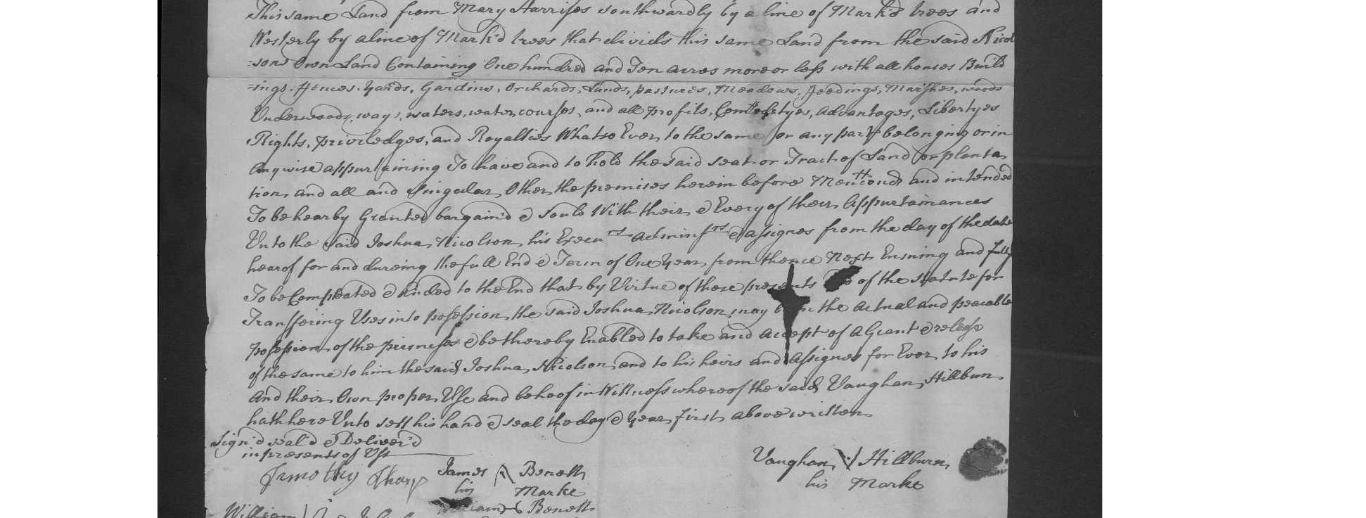
In January 1741, Vaughan Hilbun of sold his land on the north & south side of Three Creeks in Isle of Wight County to Joshua Nicholson. The last record of Vaughan Hilburn in Virginia was 26 July 1742, the date he returned the inventory of the estate of John Vaughan, deceased. This also was in Isle of Wight county.

